

Most fire and gas systems do not fail because of poor hardware or bad engineering.
They fail because the project started with the wrong question.
In many projects, fire and gas detection is treated as a necessary compliance item — something to be added late, designed conservatively, and justified against minimum standards. The discussion quickly collapses into detector counts, spacing rules, and cost containment. The goal becomes proving compliance on paper.
That approach feels safe. It often isn’t.
When fire and gas decisions are framed late, or framed around compliance rather than risk, the outcome is predictable: false confidence in detector coverage, over-engineered layouts, expensive retrofits. Or worse, credible release scenarios that are never detected under real operating conditions.
Fire and Gas Mapping exists to prevent exactly this outcome.
But it is widely misunderstood.
It is not a coverage map exercise.
It is not a way to “check” detector locations.
And it is not a tool to justify decisions that have already been made.
Used properly, fire and gas mapping is a decision-making tool. It defines what protection is actually required for the hazards present:
Before layout, cost, and compliance positions are locked in.
Common Themes That Undermine Fire and Gas Design
Across both greenfield and brownfield facilities, the same structural issues appear repeatedly. They are rarely technical failures. More often, they stem from how fire and gas detection systems' decisions are framed, timed, and justified within projects.
When these themes are present, even well-intentioned designs struggle to deliver effective detection when it actually matters.
Fire and gas mapping is treated as a late-stage check.
When mapping is introduced after layouts and philosophies are fixed, it can only justify existing decisions, not improve them. Any gaps identified at that point are expensive to address and politically difficult to correct.
Existing systems are assumed to be robust because nothing has happened.
The absence of incidents does not demonstrate effective detection. Over time, changes to plant process equipment configuration, congestion, operating conditions, occupancy and inventory quietly invalidate original assumptions, often without triggering any formal review.
Detectors are placed near perceived leak points as a proxy for coverage.
Rule of thumb and proximity-based design ignore gas dispersion behaviour, hazard design basis, congestion and enclosure effects. Intuitive layouts routinely fail to detect credible release scenarios under realistic operating conditions.

Conservative over-design is used to manage liability rather than risk.
Over-engineered systems increase capital cost, alarm load, and maintenance burden without delivering proportionate safety benefits. Conservative design is not the same as engineered performance design based on risk.
The Real Failure: Decision Framing, Not Engineering
In practice, most fire and gas shortcomings are not technical failures.
They stem from how decisions are made within projects.
Fire and gas mapping is most powerful when it is used to answer a simple but critical question:
What hazards do we actually need to detect, and what level of mitigative performance is required to reduce risk to a tolerable level if a leak occurred?
When mapping is done early, it informs hazard definition, detector philosophy, zoning strategy, and performance requirements. When it is done late, it can only rationalise decisions that were already made for other reasons, often resulting in avoidable safety and cost trade-offs.
At that point, the exercise becomes defensive rather than informative.
This is where experienced senior engineering judgement matters. Not because the calculations are difficult, but because the consequences of getting the framing wrong are expensive, persistent, and often invisible until it is too late.
What “Good” Actually Looks Like
Good fire and gas mapping does not start with detector layouts.
It starts with identifying credible hazard scenarios and a clear understanding of how fire and gas hazards behave within the specific facility environment.
Done properly, fire and gas mapping:
- Engineers detection systems for actual facility hazards, not generic rules of thumb
- Focuses on performance, not tick-box compliance or blanket conservatism
- Makes gas dispersion, enclosure effects, congestion, and release dynamics explicit
- Links detection coverage directly to mitigative risk reduction intent
- Enables proportional design, avoiding both under-coverage and gold-plating
Critically, it gives decision-makers accurate risk-based options rather than assumptions.
This performance-based approach aligns with recognised industry guidance on fire and gas system effectiveness, such as ISA TR84.00.07-2018 Guidance on the Evaluation of Fire, Combustible Gas, and Toxic Gas System Effectiveness.
Once a standard-aligned, performance-based layout is understood, project teams can make informed trade-offs. Layouts, technologies, and failure scenarios can be adjusted with a clear understanding of what is gained and what is lost, rather than guessing.
It allows decisions to be made with confidence, based on sound engineering data rather than assumptions.
Practical Implications: Existing Facilities vs New Projects
For existing facilities, fire and gas mapping provides a gap analysis against assumptions that have quietly accumulated over time.
It allows operators to:
- Understand what hazards are actually detected and what are not
- Identify genuine coverage gaps without defaulting to wholesale replacement
- Prioritise upgrades based on risk, not age or historical assumptions
- Avoid “silent non-compliance” created by years of incremental change
In many cases, the value comes not from adding detectors, but from not adding the wrong ones.
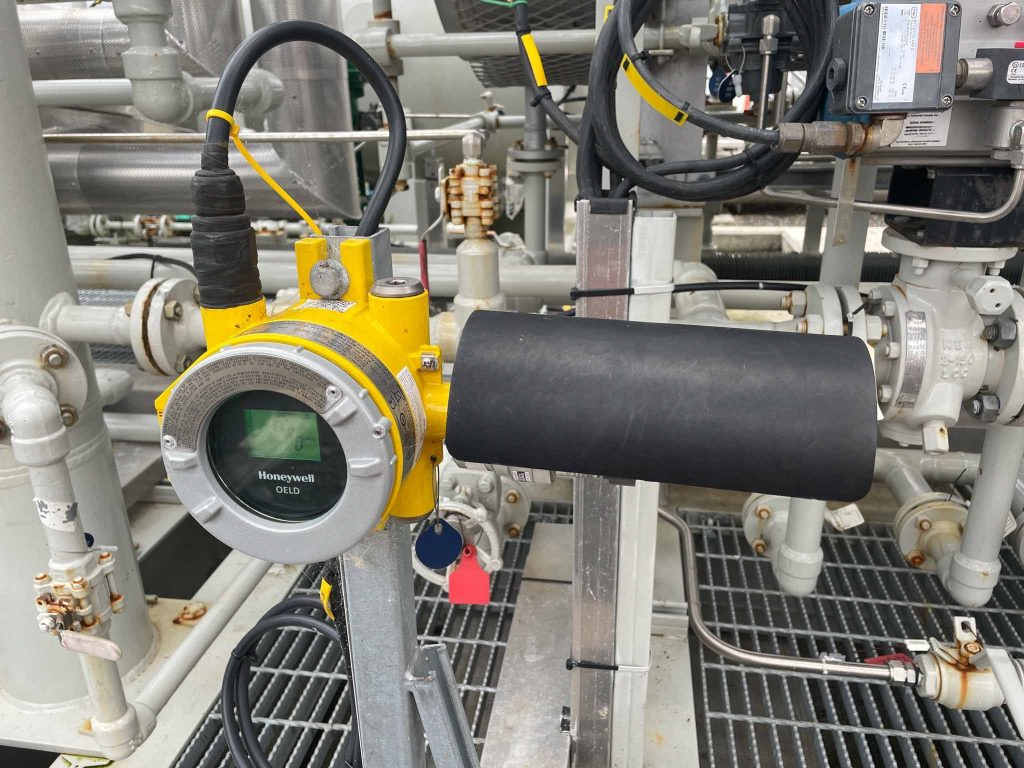
For new projects, the benefits are even more pronounced.
When fire and gas mapping is undertaken during the FEED stage, it:
- Defines scope cleanly before layouts are frozen
- Reduces late-stage design changes and rework
- Aligns safety intent with constructability and cost
- Prevents over-conservatism being locked in “just in case”
The result is fewer surprises, effective decision-making, and a system that does what it was intended to do.
How We Typically Help
We support clients with fire and gas mapping across the full project and asset lifecycle, including:
- Early-stage mapping (ideally during FEED) to define hazard detection intent and detector quantities before key design decisions are locked in
- Project support during detailed design to confirm coverage targets, define or validate detector layouts, and identify potential coverage gaps before construction
- Project support during construction to revalidate fire and gas mapping where constructability changes occur, and confirm that installed detector layouts continue to meet the original mapping intent
- Independent reviews of existing fire and gas systems to validate real-world coverage and identify compliant, risk-based improvement options
Our focus at Equinox Automation is on performance-based, risk-based fire and gas design.
A Closing Thought
The effectiveness of a fire and gas system depends as much on when decisions are made as on what is installed.
Fire and gas mapping is most effective when used to inform decisions early, rather than to justify them later.
Fire and Gas Mapping – Common Client Questions
Q: “We already have detectors installed and they meet the standard, why revisit this now?”
Because compliance does not demonstrate that credible releases would be detected under current operating conditions. Most systems are built on assumptions that drift as plants change, congestion increases, or operations evolve. A clean incident record is not evidence of effective detection. The consequence is unmanaged risk that often only becomes visible during an incident, audit, or insurance review.
Q: “Isn’t fire and gas mapping just a way to validate layouts we’ve already designed?”
No. Once layouts are fixed, mapping can only justify past decisions, not improve outcomes. Any gaps identified late are costly, politically difficult, and often accepted rather than corrected. Early mapping informs decisions. Late mapping can only defend them. That distinction determines whether risk is genuinely reduced or simply rationalised.
Q: “When should fire and gas mapping actually be done in a project?”
Before detector philosophies, quantities, and layouts are locked in, ideally during FEED or early concept design. At that stage, detection performance can shape design decisions rather than react to them. Once layout and procurement momentum takes over, options narrow quickly. The trade-off becomes early clarity versus permanent compromise.
Q: “Why not place detectors near likely leak points and be conservative?”
Because intuition and conservatism do not guarantee detection under real conditions. Gas behaviour, congestion, enclosure effects, and ventilation routinely defeat proximity-based layouts. Over-design increases capital cost, alarms, and maintenance burden without delivering proportionate safety benefit. The result is often a more expensive system that still misses credible release scenarios.
Q: “Do incremental plant changes really justify a full review?”
Yes. This is how systems quietly drift out of alignment with their original safety intent. Individual changes may appear minor, but together they invalidate detection assumptions. Without periodic review, you accumulate what regulators often describe as silent non-compliance. The choice is controlled reassessment now or forced correction later.
Q: “How do we balance safety intent against cost without overreacting?”
By defining the required risk reduction before selecting solutions. When performance intent is explicit, teams can make informed trade-offs and understand what is gained or lost. Without that clarity, decisions default to fear-driven conservatism or cost-driven shortcuts. Both produce systems that appear acceptable but perform poorly when tested.
Written by Hardie McLaren, Principal Instrumentation & Control Engineer, Equinox Automation